The Automation Revolution: Reshaping the Modern Workforce
The Automation Revolution: Reshaping the Modern Workforce
The landscape of the global job market is undergoing a seismic shift, driven by the rapid integration of automation and Artificial Intelligence. Far from being a distant futuristic concept, automation is actively redefining how industries operate, moving beyond simple repetitive tasks to complex cognitive processes.
The Shift in Job Roles
While fears of mass unemployment often dominate the conversation, the reality is more nuanced: transformation over replacement. Routine manual and clerical jobs are being phased out, but they are being replaced by roles that require high-level human skills. We are seeing a surge in demand for:
- Analytical Thinking: Interpreting data collected by machines;
- Creative Problem-Solving: Addressing nuances that algorithms cannot grasp;
- Emotional Intelligence: Managing human relationships and leadership.
The Productivity Paradox
Automation allows businesses to scale at unprecedented speeds, reducing human error and operational costs.
However, this efficiency demands a new kind of literacy. The workforce must embrace upskilling and continuous learning to remain relevant.
Adapting to the Future
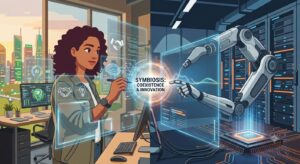
To thrive, professionals must view technology as a collaborator rather than a competitor. By delegating “robotic” tasks to software, humans are free to focus on innovation and strategy, ultimately leading to a more dynamic and fulfilling professional environment.
The workforce of tomorrow will not be defined by those who can compete with AI, but by those who can master it. This seismic shift demands a commitment to lifelong learning and a focus on high-level cognitive skills.

Latest posts by Comunicação Simdea (see all)
- WHAT IS AN IP ADDRESS AND WHY DOES IT MATTER? - 21/09/2026
- Man vs. Machine: The Era of Coexistence - 30/06/2026
- The Impact of Technology on Our Daily Lives - 31/05/2026